लेख → Lekhio
A word that means “whatever is written” — and, from the same root, “the accounts”. Which is a suspiciously exact description of an ERP you build yourself.
Three syllables, stress on the first. The “kh” is the aspirated ख of लेख — a soft breath after the k, not a throaty “ch”.
Where the word comes from
Every rung below is a real word, still in use. Only the last one is ours — and each meaning turned into a part of the product.
- लिख्likhSanskrit — the verbal root
to scratch, to inscribe, to write
The oldest sense is physical. Before it meant “to write” it meant to score a line into a surface — a stylus drawn across palm leaf or birch bark. Writing began as the act of marking a blank thing with your own hand.
In LekhioThe blank page. Every Lekhio account starts empty and waits for you to mark it. - लेखlekhSanskrit, and still everyday Nepali & Hindi
that which has been written
From the root comes the noun. In Nepal and India today, लेख is what you wrote — an article, a document, an inscription on stone. Crucially it names no particular kind of writing. Anything committed to a surface is a lekh.
In LekhioCollections. A page in Lekhio is whatever you need written down — customers, batches, machines, site visits, complaints. - लेख्यlekhyaClassical Indian legal texts
that which is to be written; a written instrument
The gerundive form carries obligation: not merely written, but meant to be written. In classical jurisprudence lekhya is the technical term for a written instrument — a deed, a contract, a record that stands as evidence because someone put it in writing.
In LekhioInvoices, orders, purchase orders, statements — the documents a business is obliged to produce and keep. - लेखाlekhāSanskrit → modern Nepali & Hindi
a line, a stroke — and, today, accounts
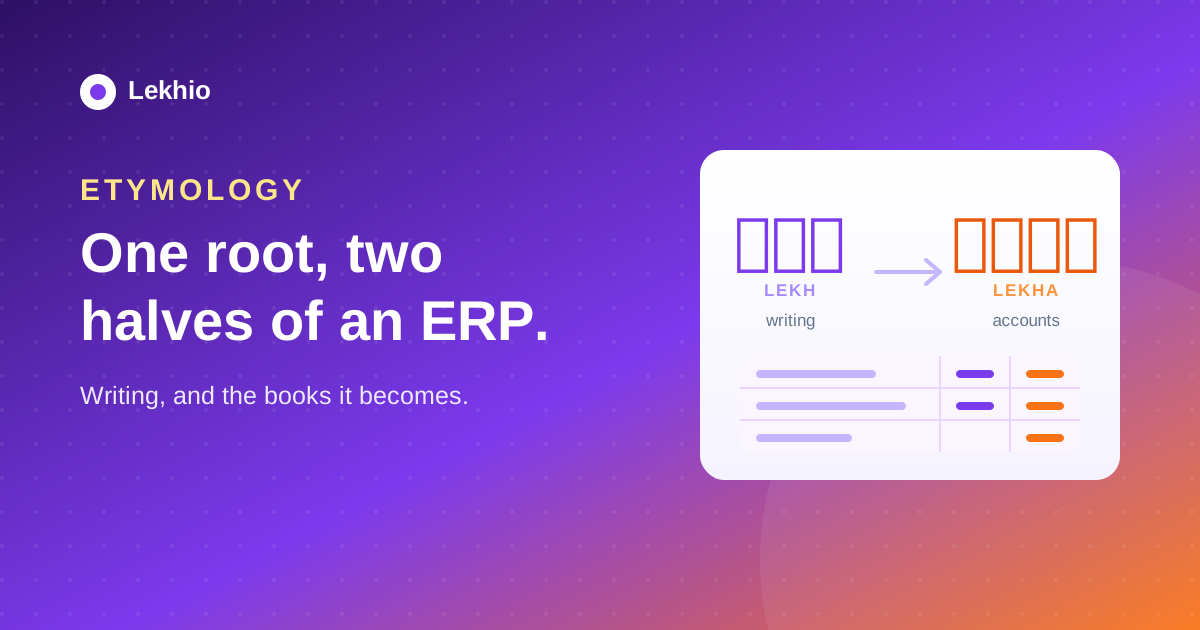
The same root gives the word for a drawn line, and from there the ruled lines of a ledger. Which is why in Nepali and Hindi the word for accounting is लेखा: an accountant is a लेखापाल, an audit is लेखा परीक्षण, the Auditor General is the महालेखा परीक्षक.
In LekhioFinance. Receivables, payments, aging, statements — the books, under the word that already means “the books”. - लेखिओLekhioThe name
whatever you need written
lekh + -io. The root belongs to this region; the suffix belongs to software. Between them sits the whole idea: a system with no opinion about what you write in it, that still knows what a ledger is.
In LekhioThe product you are looking at.
The same root reaches both ends of an ERP
One half of the word means “write anything you like”. The other half means “accounts”. Software that does only the first is a notes app; software that does only the second is every ERP you have already rejected.
Anything that can be written
No fixed forms, no fixed modules, no field somebody else decided you needed. A blank page you rule yourself — 18+ field types, your own pages, your own workflow.
- Design your own pages and fields, no code
- A spreadsheet grid that behaves like Excel
- Table, board, calendar and gallery over the same data
And the books, kept properly
Freedom without accounting is a note-taking app. Everything you write flows into real orders, real invoices, real stock and real receivables — priced, taxed, numbered and auditable.
- Itemized invoicing with PDF, QR and barcode
- Orders, purchases and per-location inventory
- Payments, aging and customer statements
The engine came first. The name had to catch up.
Lekhio is built by Lacspace Corporation Pvt. Ltd., founded in 2021 by Eallen Karna. The naming happened late — after the team had built something that refused to be one fixed thing, and then had to find a word that refused along with it.
- 1
The problem with every name on the list
The first shortlist looked like every other shortlist: Ledgerly, InvoicePro, BizSuite, StockFlow. Each one named a module. And naming a module was exactly the trap the product was built to escape — the moment the software announces it is an invoicing tool, it has already told the customer what they are allowed to do with it.
- 2
The thing the engine actually did
What had been built was not an invoicing tool. It was an engine where a business defines its own pages and fields and the rest of the system — orders, billing, stock, finance — attaches itself to that structure. A furniture workshop and a pharmacy distributor could run the same software and never see the same screen. The name had to hold that.
- 3
Going back to the root
The answer was in a word the team had used their whole lives without examining. लेख — lekh — is Nepali and Hindi for a piece of writing, from the Sanskrit root लिख्, to inscribe. It does not specify what is written. That refusal to specify was the entire product thesis, sitting in a word older than double-entry bookkeeping.
- 4
The half nobody expected
Then came the part that settled it. The same root gives लेखा — lekhā — which in Nepali and Hindi does not mean “writing” at all. It means accounts. An accountant is a लेखापाल; an audit is लेखा परीक्षण. One root, and it already reached from “write anything you like” all the way to “and here are the books”. That is the product, in a word.
- 5
The last two letters
-io was the only invention: a suffix from the software world, kept short so the name would survive a browser tab, an app icon and a phone call in three languages. Lekhio. The root is from here. The suffix is from the work.
We were not trying to name an ERP. We were trying to name a blank page that knows what a ledger is — and the word for that already existed, in the language everyone in the room grew up speaking.
Four promises the word makes
A name is only a story until the software keeps it. Each of these is a feature you can go and check.
Nothing is fixed
If it can be written down, it can be a page in Lekhio. Build your own collections with 18+ field types — relations, formulas, lookups, rollups — and the system adapts around them.
See the Collections engineWhat must be written, is
Invoices, orders, purchase orders and statements are generated, numbered and archived — customizable down to the PDF layout, with QR and barcode built in.
See invoicingThe books stay straight
Every document lands in finance. Payments, partial payments, aging, receivables and customer statements — connected, not re-keyed from another system.
See financeWritten by hand, by anyone
The whole thing is built without code. The person who knows how the business works is the person who designs the system — not a consultant with a six-month timeline.
See it by industryTwo longer reads
The etymology, and the ledger it describes — written out properly.
Questions about “Lekhio”
Meaning, pronunciation and where the word comes from.
What does “Lekhio” mean?
Lekhio comes from लेख (lekh) — the Nepali, Hindi and Sanskrit word for something written: an article, a record, an inscription. It descends from the Sanskrit root लिख् (likh), “to scratch or inscribe”. The name means, roughly, “whatever you need written” — which is the product: a system with no fixed forms that you shape to your own business.
Is “Lekhio” a Sanskrit word?
The root is. लिख् (likh) is a Sanskrit verbal root meaning to inscribe or write, and it gives लेख (lekh, a piece of writing), लेख्य (lekhya, a written legal instrument) and लेखा (lekhā, a line — and, in modern Nepali and Hindi, accounts). “Lekhio” itself is coined: lekh plus the software suffix -io.
Why is an ERP named after the word for “writing”?
Because the same Sanskrit root reaches both ends of an ERP. लेख means anything written — which is what a no-code Collections engine gives you, a blank page with no fixed modules. And लेखा, from the identical root, is the everyday Nepali and Hindi word for accounts: a लेखापाल is an accountant, लेखा परीक्षण is an audit. One word for “write whatever you need” and “keep the books” is an unusually exact description of what Lekhio does.
How do you pronounce Lekhio?
LEY-khee-oh — three syllables, /ˈleɪ.kʰi.oʊ/, written लेखिओ. The stress is on the first syllable and the “kh” is the aspirated ख of लेख: a soft breath after the k, not a throaty “ch”.
Does “lekh” really mean accounts in Nepali and Hindi?
लेख means a piece of writing. The related form लेखा (lekhā) is the one that means accounts — it is the standard term across Nepali and Hindi officialdom: लेखापाल (accountant), लेखा परीक्षण (audit), महालेखा परीक्षक (Auditor General). Both come from the same root, which is precisely why the name works for software that spans free-form data and formal accounting.
Who named Lekhio, and when?
The name was chosen by the team at Lacspace Corporation Pvt. Ltd., the company behind the product, founded in 2021 by Eallen Karna and registered in both India and Nepal. It was picked after the no-code Collections engine already existed — the engine came first, and the name had to describe something that deliberately refuses to be one fixed thing.
Do I need to speak Nepali or Hindi to use Lekhio?
No. Lekhio’s interface is in English, and the name is the only part of it you will need to pronounce. The etymology explains the design philosophy; it is not a requirement to use the product.
Is Lekhio only for businesses in Nepal and India?
No. Lekhio is built first for the realities of doing business in Nepal and India — how invoices are itemized, how receivables are chased, how stock moves — because the team lives in those markets. But a system flexible enough to model any business, connected end to end and available on web, mobile and API, serves companies well beyond the region.
A blank page, waiting to be written on
Design your own pages and fields, then run sales, billing, inventory and finance on top of them. Free to start, no credit card.